
Context
Many commercial buildings are required by the European Energy Performance of Buildings Directive (EPBD) to use a Building Management System (BMS) that monitors and controls building services, including the lighting installation. The BMS must be able to access lighting data, such as energy consumption and fault status, and support centralised lighting control.
What is the DALI bridge?
The MOTIV DALI bridge is a two-channel interface that connects the DALI-2-based Niko Lighting Management system to a BMS.
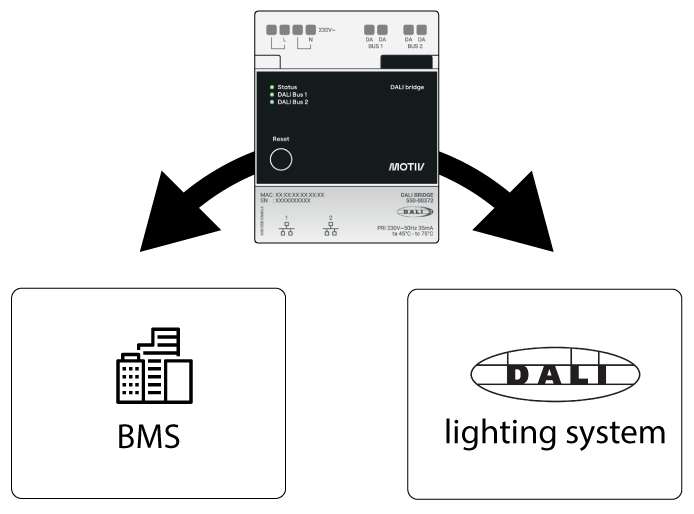
It enables communication between the lighting system and the BMS, allowing lighting data to be exchanged and lighting functions to be monitored and controlled from the building automation platform.
-
For the basics on a BMS, go to What is a BMS?. the system.
-
For more information on the Niko Lighting Management System, go to Niko Lighting architecture.
Why do you need it?
The DALI bridge crosses the gap between the lighting system and the BMS, allowing you to manage the system via the BMS:
-
It bridges the BMS and the lighting system
-
It enables information sharing
-
It allows the BMS to take action
Thus, you do not need any additional and complex controllers.
For more information, go to What does the DALI bridge do?